| Size: |
8.5” |
| Materials: |
Copper Alloy with 24 Karat Partially Gold Gilded. |
| Crafted By: |
Master artisan from Patan, Nepal. |
| Made In: |
Nepal. |
| Time to Ship: |
24 Hours |
| Availability: |
World wide delivery within 3 – 5 business days. |
| Insurance: |
Yes. |
| Speciality: |
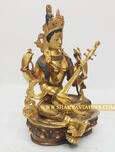
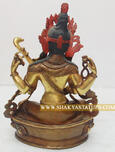
This 8.5” Saraswati Statue is beautifully carved Partially Gold Gilded and has beautifully carved which is crafted by the master artisans of Patan, Nepal. |
| |
|
This 8.5” Partially Gold Gilded Saraswati Sculpture is made from Copper Alloy with Partially Gold Gilded which is crafted by our experienced artisan of Patan, Nepal who has been in this business from generations.
Saraswati – The Goddess of Knowledge
--------------------------------------------------------------------------------------------------------------
Saraswati is the Hindu goddess of knowledge, music and the arts. Saraswati has been identified with the Vedic Saraswati River. She is considered as consort of Brahma, the Hindu god of creation. Thus, with the goddesses Lakshmi and Parvati or Durga, she forms the Tridevi ("three goddesses"), who are consorts of the male trinity of Brahma, Vishnu and Shiva, respectively. Saraswati's children are the Vedas, which are the oldest sacred texts of Hinduism.
The Goddess Saraswati is often depicted as a beautiful, white-skinned woman dressed in pure white often seated on a white Nelumbo nucifera lotus (although Her actual vahana is believed to be a swan), which symbolizes that she is founded in the experience of the Absolute Truth. Thus, she not only has the knowledge but also the experience of the Highest Reality. She is mainly associated with the color white, which signifies the purity of true knowledge. Occasionally, however, she is also associated with the colour yellow, the colour of the flowers of the mustard plant that bloom at the time of her festival in the spring. She is not adorned heavily with jewels and gold, unlike the goddess Lakshmi, but is dressed modestly — perhaps representing her preference of knowledge over worldly material things.
She is generally shown to have four arms, which represent the four aspects of human personality in learning: mind, intellect, alertness, and ego. Alternatively, these four arms also represent the 4 vedas, the primary sacred books for Hindus. The vedas, in turn, represent the 3 forms of literature:
• Poetry — the Rigveda contains hymns, representing poetry
• Prose — Yajurveda contains prose
• Music — Samaveda represents music.
The four hands also depict this thusly — prose is represented by the book in one hand, poetry by the garland of crystal, music by the veena. The pot of sacred water represents purity in all of these three, or their power to purify human thought. |
| |
|
|